Platform
Shown working
The derivations behind every value — color from a measurement, geometry from a grid. Verify them here.
Color, derived
The green ramp
OKLCH is the derivation space: a perceptually uniform lightness ladder with hue held constant, implemented in tokens/scripts/derive-color.mjs and fully deterministic. Every step below is the value the token file actually holds today.
#e4ffd8
color.green.50
#c1fca7
color.green.100
#9fed79
color.green.200
#78d643
color.green.300
#5abd00
color.green.400
#4ea400
color.green.500
#3e8600
color.green.600
#2f6800
color.green.700
#204c00
color.green.800
#112f00
color.green.900
#081c00
color.green.950
Rendered from a direct import of tokens/eyenus.tokens.json — hue held at the measured anchor’s 135.21°, lightness laddered 0.97 → 0.20 in OKLCH, chroma clamped to stay inside sRGB gamut (docs/adr/0003-color-derivation.md).
Where the ramp starts
The heritage anchor
#76e00e
The anchor
Where the ramp started: the dominant mark green pixel-sampled from the 2005 wallpaper files on a graphite background — OKLCH L 0.8104, C 0.2349, H 135.21°. Preserved exactly as a documentary reference, not normalized into any ramp.
The live ramp has since re-anchored: the founder’s luminous directive moved the mark and identity-accent anchor to #7cff00(ADR-0012). The green ramp above derives from that new anchor; the 2005 measurement stays on record here, not deleted, per this repo’s heritage-immutability discipline.
From assets/heritage/HERITAGE.md, docs/adr/0003-color-derivation.md, and docs/adr/0012-luminous-color-re-anchor.md
Geometry, derived
Mark construction mathematics
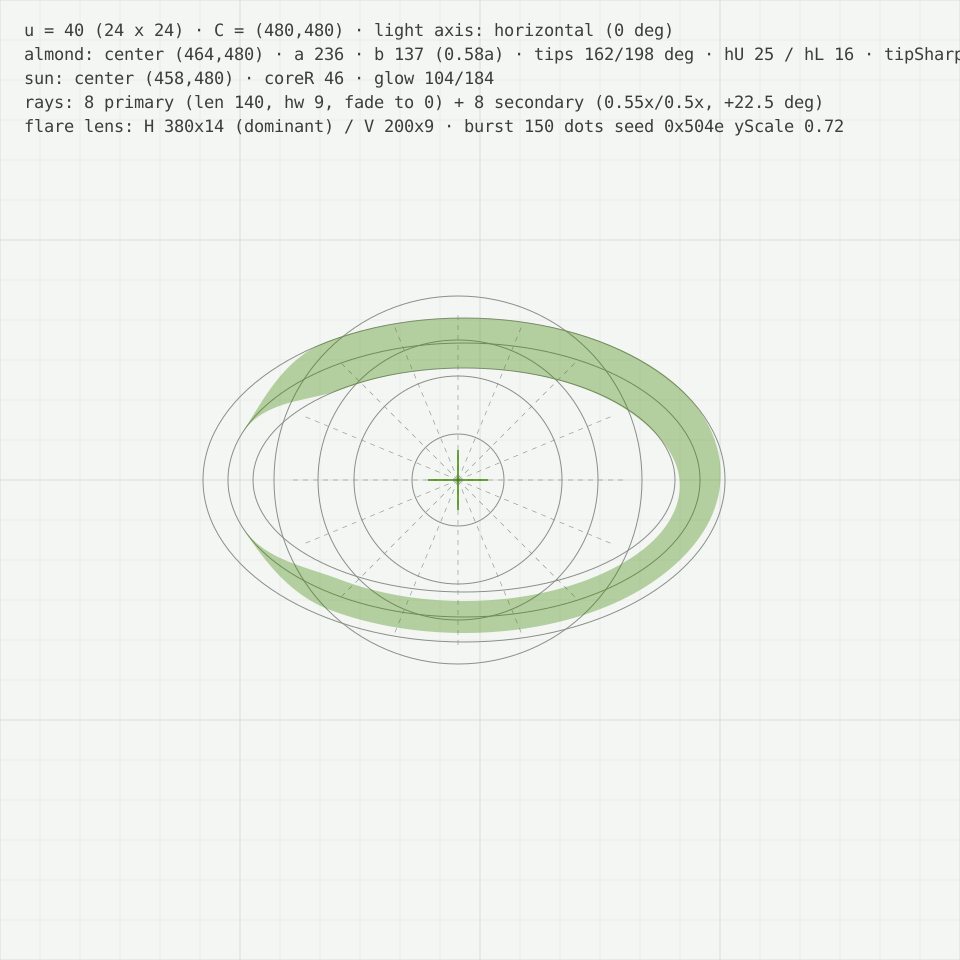
The mark is fully computable — no freehand drawing. Every variant derives from the same leaf-arc and sun parameters (ADR-0011), generated by brand/logo/scripts/generate-mark.mjs; hand-editing an emitted SVG is a build break.
- Canvas
- 960 × 960, unit u = 40 (24 × 24 cells), center C = (480, 480) · light axis: horizontal (0°)
- Leaf ellipse
- Center (464, 480) · semi-axes a = 236, b = 137 (0.58a) · tip angles 162°/198° · half-thickness upper 25 / lower 16 · tip sharpness 2.6
- Sun
- Optical center (458, 480) · core radius 46 · glow radii 104/184
- Rays
- 8 primary (length 140, half-width 9, fade to 0) + 8 secondary (0.55×/0.5× scale), secondary offset 22.5° from primary
- Flare
- Horizontal vesica 190 × 7 (dominant) · vertical vesica 100 × 4.5 — horizontal is the mark’s light axis (ADR-0011), replacing the retired 45° aperture axis
- Burst
- Seeded radial scatter, 150 dots, seed 0x504e, y-scale 0.72 — deterministic, reproducible per re-run
From docs/adr/0011-luminous-mark.md and the construction-grid master
Accessibility, verified
Contrast methodology
Every claim on this page can be re-derived from the repository. Contrast is no exception — it is asserted at build time, not checked by eye.
Method
Machine-gated, not eyeballed
tokens/test/tokens.test.mjs runs the WCAG contrast formula against the resolved token values on every test run — nine test blocks asserting twenty-three contrast pairs across both schemes, covering body text, links, and focus rings against their backgrounds, the signal green against dark surfaces, and button label colors against their accent surfaces. These are release gates: a token change that drops any pair below its minimum (4.5:1 for text, 3.0:1 for graphic and focus use) fails the build before it reaches a component.
From docs/ACCESSIBILITY.md §Machine-verified contrast